
Choosing the Right Valve for Corrosive Media: Materials, Seats, and Key Selection Factors
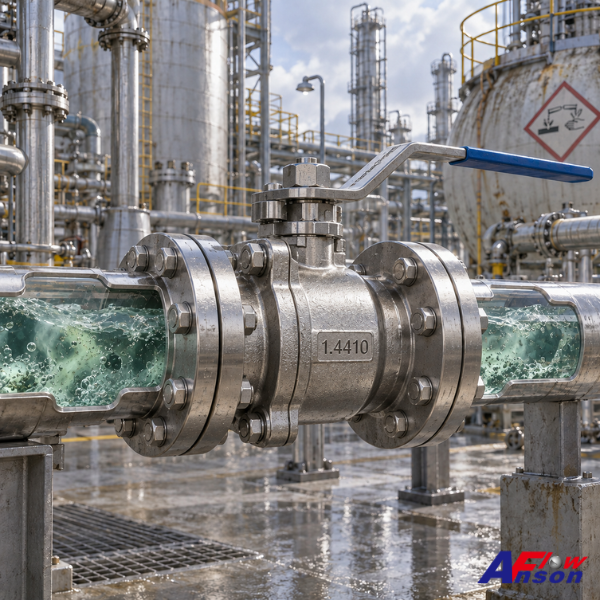
In chemical processing, water treatment, marine, and general industrial applications, selecting the right valve for corrosive media requires more than choosing a corrosion-resistant body material.
Long-term valve reliability also depends on whether the ball or disc, stem, seats, O-rings, gaskets, and other wetted parts are compatible with the actual process media.
At Anson Flow, we evaluate media type, concentration, temperature, pressure, and operating conditions to help customers select suitable valve materials, seat materials, and sealing configurations.
1. Common Valve Body Materials for Corrosive Media
Different chemicals can affect metals in very different ways, so valve body material should always be selected based on the actual service conditions.
|
Valve Body Material |
Key Characteristics |
Typical Applications |
|
316 / 316L Stainless Steel |
Good general corrosion resistance |
Chemical processing, water treatment, general industrial fluids |
|
Duplex Stainless Steel |
Improved resistance to chlorides and pitting |
Seawater, marine, chloride-containing environments |
|
Super Duplex |
Higher resistance to pitting and crevice corrosion |
Offshore, marine, and severe corrosive service |
|
Hastelloy |
Excellent resistance to many aggressive chemicals |
Chemical and specialty process applications |
|
Titanium |
Excellent resistance to seawater and certain chloride environments |
Marine and specialty chemical applications |
|
PFA Lined |
Good resistance to many acids, alkalis, and chemicals |
Corrosive chemical service |
There is no single material that is suitable for every corrosive fluid.
For example, 316 stainless steel performs well in many general applications, but more severe chloride or chemical environments may require Duplex, Super Duplex, Hastelloy, or another specialty material.
2. Seat and Seal Materials Matter Too
Even if the valve body material is suitable, incompatible seats or seals may still cause swelling, hardening, wear, leakage, or premature failure.
|
Material |
Key Characteristics |
Selection Considerations |
|
PTFE |
Excellent chemical resistance and low friction |
Suitable for a wide range of general chemical media |
|
Reinforced PTFE |
Improved mechanical strength and wear resistance |
Suitable for higher pressure or frequent operation |
|
PEEK |
High mechanical strength, wear resistance, and higher temperature capability |
Suitable for high-temperature, high-pressure, or demanding service |
|
PFA |
Excellent chemical resistance |
Suitable for highly corrosive chemical environments |
|
Delrin (POM) |
High mechanical strength, dimensional stability, and good wear resistance |
Suitable where greater support or wear resistance is required; chemical compatibility must be confirmed |
|
Metal Seat |
Suitable for high temperature, high pressure, abrasive media, and severe service |
Often used in high-temperature or particle-containing applications |
|
EPDM |
Good resistance to certain acids, alkalis, and water-based media |
Compatibility should be confirmed for the actual process fluid |
|
FKM / Viton |
Good oil, chemical, and temperature resistance |
Common in chemical and oil & gas applications |
Delrin and metal seats are selected differently from conventional soft seats.
Delrin is mainly valued for its mechanical strength, wear resistance, and dimensional stability, while metal seats are often selected for high-temperature, high-pressure, abrasive, or particle-containing service.
Seat selection should therefore consider not only chemical compatibility, but also sealing requirements, operating torque, and overall process conditions.
3. What Should Be Confirmed Before Valve Selection?
Before selecting a valve for corrosive service, the following conditions should be reviewed:
|
Selection Factor |
Why It Matters |
|
Media Type |
Different chemicals affect metals, plastics, and elastomers differently |
|
Concentration |
Corrosion behavior can change significantly with concentration |
|
Temperature |
Higher temperatures may accelerate corrosion and affect seat performance |
|
Pressure |
Influences valve body, seat, and overall design selection |
|
Flow Velocity |
High velocity may increase erosion-corrosion and wear |
|
Solid Particles |
Can cause wear on seats and sealing surfaces |
|
Cleaning Media |
Steam, cleaning chemicals, or flushing media may also affect material life |
One important point is that the same chemical may behave very differently at different concentrations and temperatures.
For this reason, general descriptions such as “acid,” “chemical liquid,” or “wastewater” are usually not enough for accurate valve material selection.
Key Factors in Corrosive Media Valve Selection
For corrosive applications, the following should be evaluated together:
Media + Concentration + Temperature + Pressure + Valve Body Material + Wetted Parts + Seat + Seals + Valve Design
A higher-grade or more expensive material is not always the best choice.
The goal is to select the most suitable material combination and valve configuration for the actual operating conditions.
4. Need Help Selecting the Right Valve?
Anson Flow offers a wide range of industrial valves, corrosion-resistant materials, seat options, and sealing configurations for chemical processing, water treatment, marine, oil & gas, and general industrial applications.
If you are looking for a valve for corrosive media, please provide:
- Process media & concentration
- Operating temperature
- Operating pressure
- Valve size & connection
- Required valve type
- Special material or testing requirements
Contact Anson Flow with your operating conditions. Our team can assist you in selecting the appropriate valve material, seat, and configuration for your application.
sales@ansonflow.com