
Diverting vs. Mixing: Choosing the Optimal L/T Port Design for Your Piping System
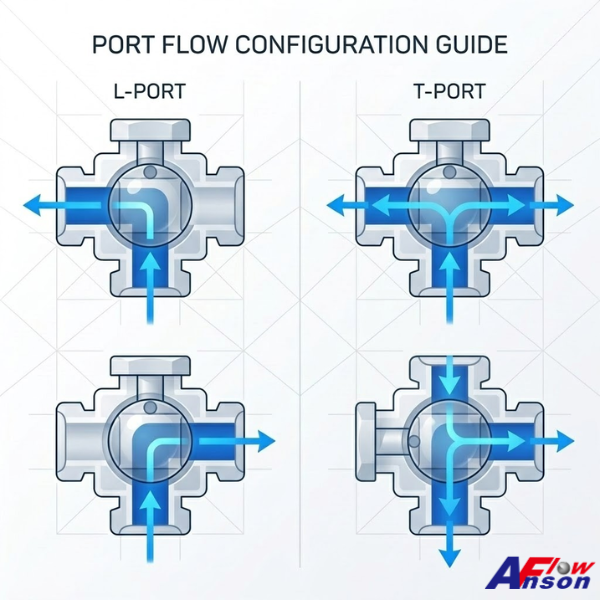
When designing multi-port fluid systems, engineers often find that the most critical decision is not the valve size, but the Port Configuration. Choosing between an L-Port and a T-Port determines not only the flow path but also directly impacts the overall operational efficiency and safety of the system.
This article explores the fundamental differences between these two flow patterns and assists you in making the optimal choice based on your specific application.
1. L-Port: The "Diverter" Expert
The purpose of the L-Port is straightforward: to divert flow from one source to one of two different outlets. The internal channel of the ball is curved at a 90-degree angle.
· Operational Logic: By rotating the ball 90 degrees, the flow is switched from "Outlet A" to "Outlet B." During the transition, both outlets are never fully open at the same time.
· Best Applications:
o Process Switching: Switching raw material sources between two different reaction tanks or storage vats.
o Bypass Systems: Diverting fluid from the main line to a filter or cooling equipment without interrupting the overall process.
2. T-Port: The "Multi-flow Master"
If your system requires higher flexibility, the T-Port is the ideal choice. Its T-shaped internal channel allows fluid to flow in multiple combinations between the three ports.
· Operational Logic: In addition to the diverting function of the L-Port, the T-Port can achieve a "three-way fully open" state.
· Best Applications:
o Mixing: Combining two different media into a single outlet.
o Dividing (Splitting): Distributing fluid from a single source to two different systems simultaneously.
· Key Advantage: A single T-Port valve can often replace multiple traditional two-way valves, streamlining space and reducing maintenance costs.
3. Selection Matrix: Which One Do You Need?
To simplify your decision-making process, refer to this comparison chart prepared by the Anson Flow engineering team:
|
Functional Requirement |
Recommended Design |
Operation Mode |
|
Pure directional switching (A or B) |
L-Port |
90° Switch |
|
Mixing two different fluids |
T-Port |
Mixing |
|
Distributing fluid to two outlets |
T-Port |
Dividing |
|
Closing the flow path and preventing mixing |
L-Port |
Divert & Block |
4. Anson Flow’s Professional Multi-way Valve Solutions
At Anson Flow, we provide a comprehensive range of multi-port ball valves designed for demanding industrial environments. Below are our recommended models based on your application needs:
Featured Models & Specifications
· AF-S2B Series (Flanged Multi-way): Our flagship product for heavy industry. Supporting ANSI 150-1500 and PN10/40 standards, with sizes ranging from 1/2" to 12" (DN15 - 300). Its robust structural integrity makes it the top choice for large-scale fluid engineering.
· AF-S2H Series (High Pressure Multi-way): Supports 3-way, 4-way, and even 5-way configurations. With pressure ratings up to 1000 / 3000 PSI, it is ideal for mid-sized process systems requiring high pressure resistance.
· AF-S2D & AF-S2T Series (Compact Design): Specifically designed for space-constrained environments (1/4" - 2"). The AF-S2T features a unique bottom-entry diverter design, offering more flexible piping options.
· AF-75 Series (Instrumentation Valve): Built for instrumentation systems, supporting up to 3000 PSI. Perfect for precision control and sampling analysis.
Why Choose Anson Flow?
1. Advanced Sealing Technology: Most of our multi-way valves feature a 4-Seat Design, which perfectly balances internal pressure and ensures bubble-tight shut-off in any flow configuration.
2. Automation-Ready: Products are equipped with an ISO 5211 direct mounting pad, allowing for seamless integration with pneumatic or electric actuators.
3. Precision-Machined Balls: Every L/T ball is precision-ground to ensure a smooth flow path, minimizing pressure drop and turbulence.
Get Expert Selection Advice & Quotations
Choosing the right port design is the first step toward a successful engineering design. Whether you need a simple diversion or a complex multi-directional distribution process, the Anson Flow technical team is here to provide the precise support you need.
If you require a quotation for L-Port or T-Port configurations, or wish to request product drawings, please contact us directly:
Email: sales@ansonflow.com
Our sales engineers will provide professional model recommendations and a competitive quote based on your specific piping diagrams.