
RF, RTJ, or FF? Choosing the Right Flange Face for a Flanged Valve
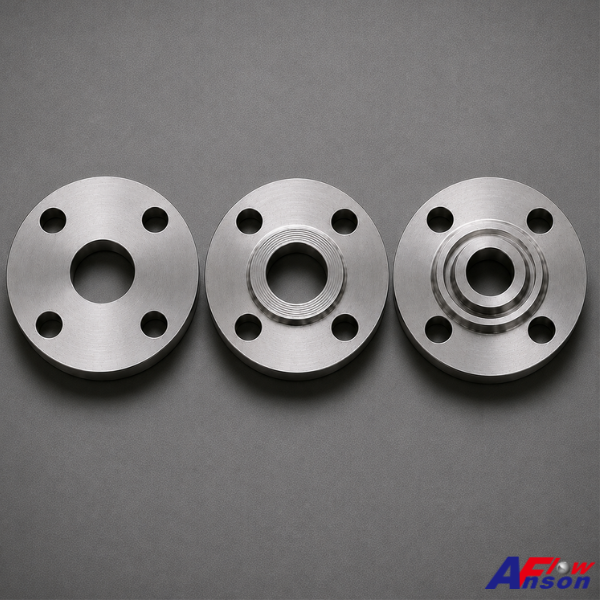
When engineers specify a flanged valve, most of the attention goes to body material, pressure class, and trim. The flange face — the finished surface where the gasket actually seals — often gets treated as an afterthought. Yet it is exactly where a joint either leaks or holds. Pick a face that is wrong for the pressure, the temperature, or the mating flange, and you end up with either a leak path or money spent on capability you will never use.
Here are the three flange facings you will actually meet in the field, and where each one belongs.
Raised Face (RF) — the default workhorse
The RF is the most common facing in process piping. A small raised surface — 1.6 mm (1/16") on Class 150 and 300, 6.4 mm (1/4") on Class 400 and above — concentrates the bolt load onto a defined gasket area. It works with flat ring or spiral-wound gaskets and covers the vast majority of general service from Class 150 to 2500.
Use it for: general water, oil, gas, steam, and process service at moderate pressure and temperature — the sensible default unless something specific pushes you off it.
Flat Face (FF) — for cast iron and low pressure
An FF flange mates across its whole face with a full-face gasket. Its main job is to protect brittle mating flanges: bolting a raised face against a cast-iron flange can crack it as the studs pull the raised faces together, so equipment like cast-iron pumps and low-pressure vessels is specified FF.
Use it for: connections to cast-iron or bronze equipment, and low-pressure Class 125/150 utility service.
Ring-Type Joint (RTJ) — high pressure, high temperature, critical service
An RTJ has a machined groove that seats a solid metal ring gasket (oval or octagonal). Made up by the bolt load, the ring deforms into the groove to form a metal-to-metal seal — the most leak-tight facing in common use, and the standard choice where failure is not an option. For the highest-pressure and wellhead duty, pressure-energized RX and BX rings take the same principle further.
Use it for: Class 900, 1500, and 2500; high-temperature service; and critical hydrocarbon duty — wellheads, high-pressure gas, refinery hot lines.
How to Choose — the Short Version
|
Facing |
Typical class |
Seal |
Best for |
|
FF |
125 / 150 |
Full-face gasket |
Cast-iron equipment, low pressure |
|
RF |
150 – 2500 |
Flat / spiral-wound gasket |
General process — the default |
|
RTJ |
900 – 2500 |
Metal ring, metal-to-metal |
High P/T, critical hydrocarbon |
Two rules of thumb tie it together: as pressure and temperature climb, you move FF → RF → RTJ; and always match the mating flange — the same face, the same finish, and for RTJ the same ring number.
Don't Forget the Surface Finish
Even a correct RF leaks if its finish is wrong for the gasket. RF faces carry a defined serrated finish — commonly 125–250 µin AARH (Ra ≈ 3.2–6.3 µm) — that gives a spiral-wound or sheet gasket something to bite into. Too smooth and the gasket slips; too rough and it will not seal. It is a small spec that quietly decides whether the joint holds.
Anson Flow Flanged Valves
Anson Flow supplies flanged gate, globe, ball, and check valves with RF or RTJ facings to ASME B16.5 / B16.47, dimensioned and rated to ASME B16.34 (and API 6D where applicable) — so the valve's face, class, and finish match the flange it bolts to.
Tell us your class, service, and the mating flange facing, and our engineering team will confirm the right face and finish for the joint.