
Floating vs. Trunnion Ball Valves: When Is It Time to Upgrade? A Practical Selection Guide
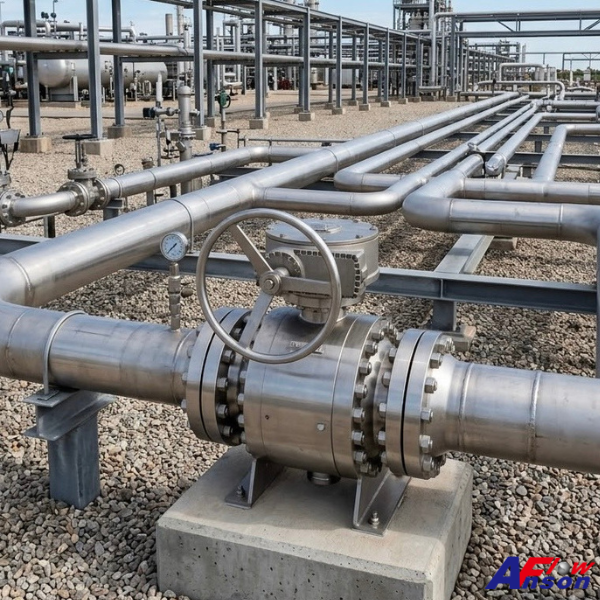
In ball valve specification, one of the most common — and most costly — mistakes is using a Floating ball valve where a Trunnion design was actually required. The two look similar on paper. They share the same operating principle. They often appear in the same flange standard catalog. But under the wrong conditions, a Floating valve will leak, an actuator will stall, and your maintenance team will be replacing seats far earlier than the lifecycle cost model predicted.
The question every project engineer eventually asks is simple: at what point does a Floating ball valve stop being the right answer, and a Trunnion design become mandatory?
This article lays out the engineering boundary — where the two diverge mechanically, where the cost curve crosses, and how to confidently specify the right valve for high-pressure, large-bore, or high-cycle applications.
At Anson Flow, our flagship AF-50T Trunnion Mounted Ball Valve (ANSI 150–1500, 2"–28") is purpose-engineered for the conditions where Floating designs reach their limit.
1. The Mechanical Difference: How the Ball Is Supported
The names tell most of the story.
Floating Ball Valve
The ball is not mechanically anchored to the body. It is suspended between two seats, free to "float" along the flow axis. When the valve closes, upstream pressure pushes the ball against the downstream seat — and that pressure is exactly what creates the seal.
This is elegant for small valves: fewer parts, simpler assembly, cheaper to manufacture. But it has a built-in tradeoff. The higher the upstream pressure, the harder the ball is jammed against the downstream seat. That force has to be overcome every time the valve opens.
Trunnion Mounted Ball Valve
The ball is mechanically fixed top and bottom by two trunnions (pivot shafts). It does not move along the flow axis. Sealing is performed by spring-energized, pressure-assisted seats that move toward the ball, not the other way around.
This decouples sealing force from operating torque. The valve can shut off 1500-class pressure and still be operated by a manageable actuator.
That single difference — who moves to seal: the ball, or the seat? — is the root of everything that follows.
2. The Three Failure Modes That Drive the Floating-to-Trunnion Upgrade
Failure Mode 1: Operating Torque Explosion at High Pressure
In a Floating valve, operating torque scales roughly with pressure × ball diameter². Double the pressure, and torque roughly doubles. Go from 4" to 8", and torque can quadruple.
In real procurement terms, this means:
- A 6" Class 150 Floating valve might need a modest 90 Nm actuator
- The same 6" valve at Class 600 may require 400+ Nm — pushing into expensive heavy-duty pneumatic territory
- At Class 900 and above, actuator cost can exceed the valve cost itself
In a Trunnion design, the ball doesn't translate under pressure. Operating torque stays manageable even at Class 1500 — which is precisely why long-distance gas transmission lines, refinery isolation valves, and high-pressure ESD systems specify Trunnion almost universally.
Failure Mode 2: Downstream Seat Wear and Galling
Every time a Floating valve cycles under pressure, the ball is dragged across the downstream seat under full sealing load. In low-cycle service this is acceptable. In high-cycle automated service — emergency shutdown drills, batch process isolation, frequent line switching — the soft seat wears predictably, and metal-to-PTFE galling can begin within months.
A Trunnion valve's seats are pushed onto the ball only when sealing is needed. The contact load is engineered, not pressure-dependent. Seat life under cycling is dramatically longer.
Rule of thumb: if your application sees more than ~50 cycles/day at Class 600+ or any cycling at Class 900+, Trunnion is the conservative spec.
Failure Mode 3: Sag and Sealing Loss on Large-Bore Valves
A ball is heavy. A 12" stainless steel ball can weigh over 40 kg; a 24" trunnion ball is in the hundreds of kg. In a Floating design, that mass hangs entirely on the downstream seat when the valve is closed, and on the seats and stem when open.
Above roughly 6", gravity becomes the dominant load on the downstream seat — not pressure. The result is uneven seat wear, drooping that distorts the sealing line, and accelerated leakage at the bottom of the bore.
Trunnion valves transfer the entire ball weight into the body through the upper and lower trunnion bearings. The seats see only the loads they were designed for.
3. The Selection Matrix: A Practical Boundary
Based on two decades of supplying valves to the EU, US, Japan, and ANZ markets, here is the working envelope our engineering team uses when reviewing client specifications:
|
Condition |
Floating Acceptable |
Trunnion Recommended |
Trunnion Mandatory |
|
Size |
≤ 4" |
6" – 8" |
≥ 10" |
|
Pressure Class |
≤ 300 |
600 |
≥ 900 (ANSI 1500 routine) |
|
Cycle Frequency |
Low (manual, infrequent) |
Moderate automated |
High-cycle ESD / process isolation |
|
Service |
General industrial liquid/gas |
Hydrocarbon transmission, sour gas |
Long-distance pipeline, offshore, LNG, high-pressure ESD |
|
Bidirectional Sealing Requirement |
Optional |
Recommended |
Required (API 6D) |
|
Antistatic / Firesafe Stack Required |
Sometimes |
Often |
Always |
4. What a Properly Engineered Trunnion Valve Actually Delivers
The mechanical principle is only half the story. A real-world Trunnion valve has to integrate several engineering layers to live up to its specification. The Anson Flow AF-50T is built around the following:
Body Cavity Pressure Relief Design
To prevent over-pressurization caused by thermal expansion of trapped liquid in the body cavity, the AF-50T incorporates a cavity pressure relief design that safely vents excess pressure when it exceeds the design limit — protecting the seats from deformation and the body from rupture. This is a critical safety feature in liquid hydrocarbon, LNG, liquid nitrogen, and other thermally cycling services. Specific relief configurations can be discussed per project.
Double Block-and-Bleed (DBB) Capability
The AF-50T combines independent dual-seat sealing with a body cavity bleed port to provide true DBB functionality. This means during maintenance or downstream inspection, upstream and downstream pressure can be fully isolated, and seal integrity can be verified through the bleed port — the standard requirement for refinery isolation valves, long-distance transmission lines, and critical petrochemical block points.
Spring-Energized, Pressure-Assisted Sealing
Initial sealing is provided by springs behind each seat. Under operating pressure, the upstream pressure further loads the upstream seat — so the valve seals both at low pressure (springs) and high pressure (assist), without relying on ball movement.
Firesafe + Anti-Static + NACE Stack
For oil, gas, and petrochemical service the AF-50T can be built with:
- API 607 / API 6FA fire-test compliance
- Anti-static contact path between stem, ball, and body (resistance ≤ 10⁹ Ω)
- NACE MR-0175 compliant materials for sour service (H₂S)
- PED 2014/68/EU + ATEX certification for European projects
Full Material Traceability
Every AF-50T ships with EN 10204 3.1 material certification and in-house PMI (XRF) verification — the same quality stack we've documented across our Firesafe and Cryogenic lines.
5. Anson Flow's Commitment to Trunnion Applications
The AF-50T Trunnion Mounted Ball Valve is engineered for the conditions where Floating designs reach their mechanical limit:
- Size range: 2" – 28"
- Pressure class: ANSI 150 – 1500 (PN 20 – PN 250 equivalent)
- Certification stack: API 6D / API 607 / NACE MR-0175 / PED / ATEX available on request
- Materials: WCB, CF8M, LF2, duplex, super duplex, and other special alloys to specification
- End connections: RF, RTJ, BW, and hub-end available
For projects supplying long-distance gas transmission, refinery main blocks, LNG receiving terminals, offshore platforms, or any high-pressure ESD system — the AF-50T is built around the standards your auditors and end-users will actually verify.
Ready to Re-Evaluate Your Next Specification?
Share your application conditions with us — line size, pressure class, fluid composition, cycle frequency, and applicable standards (API 6D / NACE / PED / ATEX) — and we will help you confirm whether Floating is still the right call, or whether Trunnion is the spec you should be writing.
📩 Contact our experts: sales@ansonflow.com
🌐 Explore the AF-50T Trunnion series: https://www.ansonflow.com/product-category/trunnion-ball
📥 Browse our complete catalog: https://www.ansonflow.com/images/AnsonFlow%20E-Catalogue.pdf