
Natural Gas Valve Selection: The Three Safety Layers That Must All Be Met
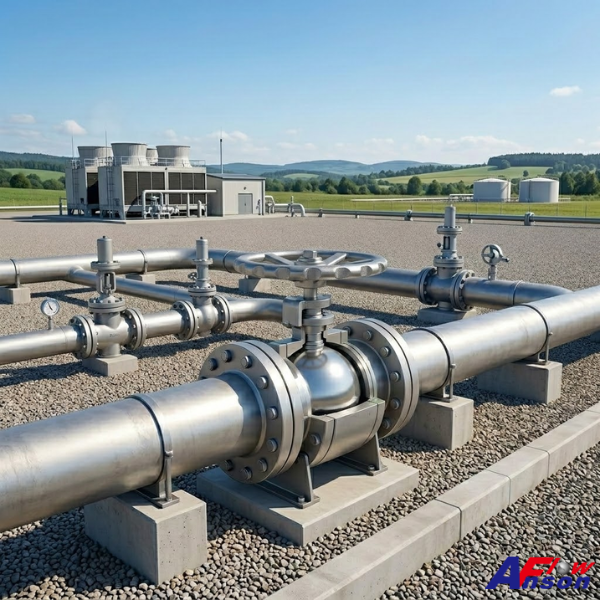
When specifying valves for a natural gas pipeline, there's one question that engineers, buyers, and auditors all ask — but the answer is rarely as simple as it sounds: "Is this valve suitable for my natural gas application?"
Answering that question requires looking beyond any single standard. Natural gas is both a high-pressure and a flammable fluid, which means a valve that can be safely deployed in a natural gas line must satisfy three layers of safety design:
1. Pressure containment — the valve body must not fail structurally at working pressure (covered by PED 2014/68/EU and equivalent standards)
2. Sealing integrity in a fire — the valve must continue to shut off gas even when an external fire occurs (covered by Fire-safe design)
3. Ignition prevention in flammable atmospheres — the valve itself must not become an ignition source (covered by Anti-static design)
Each layer has its own regulatory framework, and none of them can be skipped. This article walks through all three, the standards that govern them, and how Anson Flow's Firesafe series integrates the full set of requirements.
1. Layer One: Pressure Containment — PED and Related Standards
PED (Pressure Equipment Directive 2014/68/EU) is the EU's mandatory directive for pressure equipment. It governs the structural safety of valves, vessels, and piping at their specified pressure and temperature, covering:
· Material selection and metallurgical certification
· Wall thickness and pressure design calculations
· Welding procedures and welder qualifications
· Factory hydrostatic testing
· CE marking and technical documentation
A valve holding PED certification means it will not rupture under normal working pressure — the baseline for any natural gas application, but not the only requirement.
Other commonly referenced standards in this layer include ASME B16.34 (pressure-temperature ratings, widely used on North American pipelines) and AD2000 (the German pressure equipment code).
But pressure containment only addresses one thing: that the valve body itself doesn't fail structurally. It cannot speak to sealing performance during a fire, and it cannot speak to ignition risk in flammable atmospheres. Both of those require their own layer of regulation.
2. Layer Two: Sealing Integrity in a Fire — Fire-safe Design
If a fire breaks out near the pipeline and the valve's PTFE soft seat melts and loses its seal, natural gas will continue to escape uncontrolled through the failed valve — turning the fire scene into an explosion continuously fed by natural gas.
This is why valves in natural gas, oil refining, petrochemical, and offshore service almost universally require Fire-safe design:
· When the soft seat burns away, the ball drops onto a metal-to-metal secondary seat, maintaining basic shutoff function
· Body seals are upgraded to graphite or expanded graphite gaskets that do not melt at high temperature
· The complete valve must pass API 607 / ISO 10497 / BS 6755 Part 2 fire-test protocols (typical test: a 1027 °C flame applied continuously for 30 minutes, with leakage measured under specified limits within 10 minutes after the flame is extinguished)
The point of Fire-safe is not "the valve won't get burned" — it's "even if it does get burned, gas will not continue to escape and feed the fire."
3. Layer Three: Ignition Prevention in Flammable Atmospheres — Anti-static Design
When natural gas flows through a valve at high velocity, friction between the gas molecules and the ball, seat, and body surfaces generates static charge buildup.
The problem is that PTFE seats are insulators — there is no natural conductive path between the ball and the valve body. If the accumulated charge discharges as a spark, and the surrounding atmosphere contains flammable natural gas or volatile vapors, the result is ignition.
This is why natural gas service requires valves with an Anti-static device:
· A conductive spring or contact between the stem, ball, and body creates a deliberate electrical continuity path
· The standard requirement: resistance from ball → stem → body must be ≤ 10⁹ Ω
· In ATEX Zone 1 / IECEx Zone 1 areas (where flammable atmospheres are likely present), this is mandatory under the ATEX 2014/34/EU directive — not an option.
4. The Regulatory Matrix for Natural Gas Valves
The standards above cover different layers, and in real specification work they should be treated as stacked requirements rather than alternatives:
|
Standard |
What it covers |
Status |
|
PED 2014/68/EU |
Pressure containment (prevention of rupture) |
EU mandatory for pressure equipment |
|
ATEX 2014/34/EU |
Equipment used in explosive atmospheres (includes anti-static requirements) |
EU mandatory in Ex areas |
|
API 607 / ISO 10497 / BS 6755-2 |
Fire-safe burn testing |
Widely required across industry |
|
API 6D |
Dedicated standard for oil and gas pipeline valves (fire-safe + anti-static + full bore + bidirectional sealing) |
Frequently specified for long-distance gas transmission |
|
API 608 |
General standard for metal ball valves |
Foundation for design and testing |
|
NACE MR-0175 / ISO 15156 |
Anti-corrosion material requirements for sour gas (H₂S) service |
Mandatory in H₂S environments |
|
ASME B16.34 |
Pressure-temperature ratings for flanged valves |
Commonly used on American pipelines |
Specification tip: If a project spec lists only a single standard (e.g. PED alone, or API 607 alone), it's worth confirming a few application details before placing the order — whether the fluid is natural gas or another flammable medium, whether the installation site is an ATEX/IECEx Ex area, and whether the gas contains H₂S or other sour components. These conditions determine which standards must apply simultaneously.
5. Anson Flow Firesafe Series: Three Layers Integrated
Our complete Firesafe ball valve range is designed with Fire-safe construction and an Anti-static device integrated together, covering applications from general natural gas distribution to sour gas service and offshore platforms:
|
Application |
Recommended Model |
Key Reasons |
|
Threaded end, sour natural gas (H₂S) |
AF-280 |
NACE MR-0175 + API 607 |
|
High-pressure wellheads, transmission |
AF-291H |
6000 PSI + Firesafe |
|
Automated process lines, serviceable |
AF-35 / AF-35M |
3-piece + Firesafe |
|
Main gas pipelines, ANSI flanged |
AF-50F / AF-51F |
API 607 7th + Anti-static + full bore |
|
DIN-spec market main pipelines |
AF-52F / AF-53F |
DIN PN10–40 + Firesafe |
|
One-piece flanged, tight installation space |
AF-58F |
1-piece strength + Firesafe |
6. Anson Flow's Commitment to Natural Gas Customers
There is no "should be enough" specification for natural gas — every standard in the matrix above corresponds to an incident that has actually happened in the field. Pressure containment, Fire-safe, and Anti-static are three layers that cannot be reduced to two, and a mature valve supplier should be able to integrate all three in a single valve and provide the corresponding certification documents.
The Anson Flow Firesafe series, from material selection (WCB, CF8M, special alloys on request) through structural design to factory testing, is built to meet the most demanding requirements in oil and gas service.
If your customers are working on natural gas transmission, oil refining, petrochemical plants, offshore platforms, LNG receiving terminals, or city gas distribution networks — we can help clarify the application environment, match the right model to the applicable regulations, and provide the full certification documentation to back it up.
Ready to Specify the Right Valve for Your Next Natural Gas Project?
Share your application conditions with us — fluid composition (including any H₂S content), pressure and temperature, and the applicable standards (PED / ATEX / API 6D / NACE etc.) — and our engineering team will help match the most suitable model.
📩 Contact our experts: sales@ansonflow.com
🌐 Browse the Firesafe series: https://www.ansonflow.com/product-category/firesafe-valve