
The Valve That Can't Be Left Open: Fail-Safe Manual Operation with a Spring Return Handle
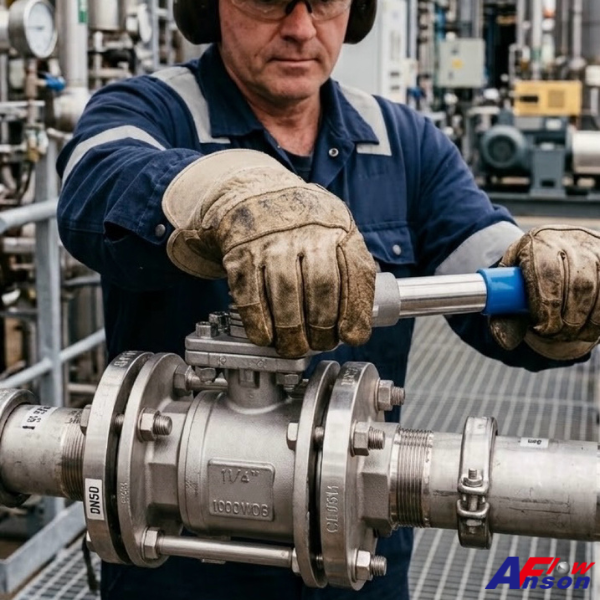
Ask any plant safety engineer for the most common valve incident, and the answer is rarely dramatic. It's not a burst body or a fire-melted seat — it's a manual valve that was simply left open when it should have been closed. A sampling valve nobody shut. A drain cracked open after a shift change. A loading line walked away from while still flowing.
None of these are equipment failures. They come from one design assumption we rarely question: that a conventional lever valve stays wherever the last person left it. The Spring Return Handle (SRH) removes that assumption — it makes closed the default state of the valve.
A Different Kind of Safety: Designing Out Human Error
Most valve safety features protect against what the fluid can do — pressure containment, Fire-safe, Anti-static. All of them assume the valve is already in the right position. A Spring Return Handle protects against what the operator forgets to do.
The principle is "dead-man" operation:
· The valve is open only while someone is physically holding the handle.
· Release it — on purpose, by accident, or by walking away — and an internal spring drives it closed automatically.
This makes the valve mechanically normally-closed. Flow isn't the resting state someone has to remember to stop; stopped is the resting state, and flow exists only while an operator is present and engaged. The single largest cause of manual-valve incidents — human error — isn't trained against or proceduralized. It's designed out of the mechanism.
Fail-Safe Closure — No Air, No Power, No Actuator
There's already a known way to get normally-closed behaviour: a spring-return actuator that fails closed on loss of signal. It works, but it brings an air supply, tubing, solenoids, and a control loop with it — far more than a sampling tap, manual drain, or hose station needs.
The SRH delivers fail-safe, normally-closed operation on a purely manual valve — no air, no electricity, no actuator to specify or service. The "fail-safe signal" is simply the operator's hand leaving the lever. And with roughly 3× the torque efficiency of a conventional handle, holding it open stays practical rather than something operators try to defeat.
Where the "Must Not Stay Open" Logic Belongs
SRH isn't for every valve — a process isolation valve meant to stay open for months is the wrong candidate. It earns its place wherever open should be a brief, supervised, momentary state:
· Sampling and testing points — flow only while the sample is drawn.
· Fuel handling, loading, and transfer — never left flowing unattended.
· Drain, vent, and blowdown — momentary open, guaranteed re-close.
· Batch dosing and manual filling — flow tied to operator presence.
· Marine, offshore, and fire-protection systems — where predictable default states are non-negotiable.
Across oil and gas, chemical, pharma and food, and water treatment, these are exactly the points where "someone left it open" becomes a spill, a cross-contamination event, or a reportable incident.
The AnsonFlow SRH Series
|
Model |
Base Valve |
|
AF-SRH |
Core spring-return handle on Anson Flow's ISO 5211 valve platforms |
|
AF-23 |
Compact two-way ball valves |
|
AF-35 |
3-piece ball valves — serviceable process lines; API 607 fire-safe |
|
AF-51 |
Flanged ball valves; API 607 fire-safe versions available |
Each adds automatic spring-return (dead-man) closure with ~3× torque efficiency on ISO 5211 two-way and flanged ball valves — fail-safe operation specified simply by choosing the spring handle in place of a standard lever. And on the AF-35 and AF-51, that operational safeguard can sit on top of an API 607 fire-safe base valve — pairing dead-man closure with certified fire performance on a single valve.
Procedures and training ask people to remember. A Spring Return Handle asks nothing — it just makes closed the state the valve returns to on its own.
📩 sales@ansonflow.com 🌐 https://www.ansonflow.com/product-category/spring-return-handle