
Not All Ball Valve Vent Holes Are the Same: Top Equalizing Hole vs. Upstream Relief Hole
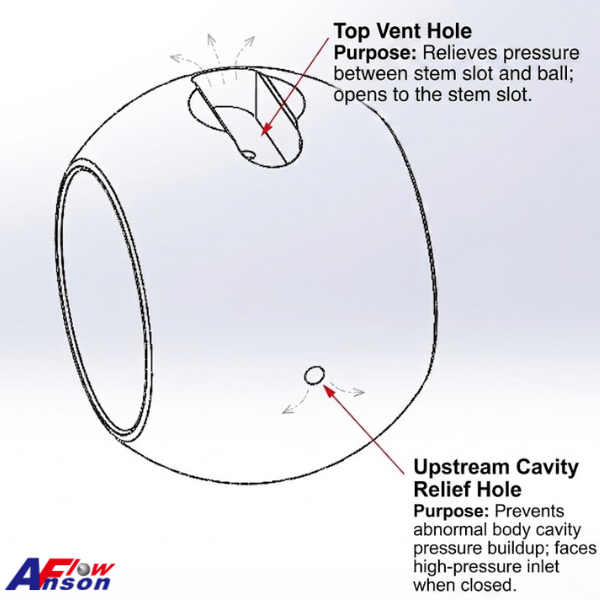
When reviewing a ball valve drawing or the actual valve itself, you may notice a small hole drilled into the ball.
This feature is often generally referred to as a vent hole, relief hole, or pressure equalizing hole. However, not every hole serves the same function.
In ball valve design, two commonly confused features are:
· Pressure equalizing hole at the top of the ball
· Upstream relief hole used for one-way sealing / cavity pressure relief
Although both are related to pressure management, their purpose, pressure path, and effect on flow direction are quite different.
1. Pressure Equalizing Hole at the Top of the Ball
The first type is a small hole located near the top of the ball, typically close to the stem slot.
Its main purpose is to connect the ball port with the valve body cavity, allowing pressure around the ball to equalize more easily.
This design can help:
· Equalize pressure around the ball
· Reduce unnecessary differential pressure across the ball
· Minimize mechanical load caused by pressure imbalance
However, there is an important point to understand:
A pressure equalizing hole does not necessarily provide complete cavity pressure relief.
When the valve is fully closed, depending on the ball geometry and hole location, this passage may not directly relieve trapped body cavity pressure back into the pipeline.
Therefore, if the application has a significant risk of trapped cavity pressure, a dedicated relief design may still be required.
2. Upstream Relief Hole for Cavity Pressure Relief
Another common design is a relief hole drilled through one side of the ball.
When the valve is in the closed position, this hole is intentionally oriented toward the designated upstream side.
If the fluid trapped inside the valve body cavity expands due to temperature increase, vaporization, or thermal expansion, the cavity pressure can then be released back toward the upstream pipeline.
This design is commonly considered for applications such as:
· Cryogenic service
· LNG
· Liquid nitrogen
· Volatile fluids
· Liquids with significant thermal expansion
· Other special services where excessive cavity pressure must be avoided
Compared with a top pressure equalizing hole, the function of an upstream relief hole is more direct:
It creates a defined pressure relief path between the valve body cavity and the designated upstream side.
Why Does This Design Make the Valve Unidirectional?
This is one of the most important differences between the two designs.
When the relief hole is drilled on only one side of the ball, that side must be installed toward the designated upstream direction.
When the valve is closed, trapped cavity pressure must be relieved through this opening back to the upstream side.
As a result, even if the standard valve design is capable of bidirectional shutoff, adding an upstream relief hole normally creates a defined flow direction and makes the valve effectively unidirectional.
The flow direction marking on the valve body should therefore always be followed.
Incorrect installation direction may not only prevent the intended cavity pressure relief function, but may also affect the sealing performance of the seat.
Two Small Holes — Two Different Functions
|
Design |
Main Function |
Typical Location |
Affects Flow Direction? |
|
Top Pressure Equalizing Hole |
Equalizes pressure between the ball and body cavity |
Top of ball / near stem slot |
Usually no |
|
Upstream Relief Hole |
Relieves trapped cavity pressure toward the designated upstream side |
Side of ball |
Yes, usually directional |
From the outside, both designs may appear to be nothing more than a small drilled hole.
From an engineering perspective, however, they serve very different purposes.
When Selecting a Ball Valve, Don’t Just Ask “Does It Have a Vent Hole?”
For cryogenic, high-pressure, volatile, or thermally expanding media, the important question is not simply:
“Is there a hole in the ball?”
Instead, the valve design should be evaluated based on:
· Is the hole for pressure equalization or cavity pressure relief?
· Which side does the cavity pressure relieve to?
· Does the valve require a specific installation direction?
· Is the seat design bidirectional or unidirectional?
· Is trapped cavity pressure possible under the actual operating conditions?
These details can directly affect valve safety, sealing performance, and installation.
Need Help Selecting the Right Pressure Relief Design?
Anson Flow provides ball valve solutions for cryogenic, high-pressure, fire-safe, and special service applications.
If you are unsure whether your application requires a top pressure equalizing hole, upstream vented ball, or another cavity relief design, send us your operating medium, pressure, temperature, valve size, and flow direction requirements.
Our team can help evaluate the appropriate valve configuration for your application.
Website:
www.ansonflow.com
Sales & Technical Inquiry:
sales@ansonflow.com
Talk to Anson Flow about your valve application today.